Akan Gold Eyewear

Photo credit: Jean-Yves Clavreul (Portraits of Anyi leaders). Photographer: J.C. Nourault, Ivory Coast (Period 1950-1970).

Akan chief’s ceremonial eyeglasses, Côte d’Ivoire (4.75” x 1.65” x 4.5”). An XRF analysis revealed an alloy of mainly silver and gold (4K) with a small copper percentage. Akan regalia eyewear served a very specific purpose. Besides displaying the high status and wealth of the chief (European items were often seen as status symbols and recreated in gold), the mesh prevented people from directly looking into the eyes of the chief which emphasized his high status and authority. This can also be seen when subjects come to greet Akan chiefs. One would not look directly into the eyes of the chief and would support one arm with the other arm when shaking the hand of the chief. This gesture shows that the chief is so powerful, that you have to support your arm just to shake his hand. Provenance: Jacaranda Gallery, New York, Ex Dr. Roy Sieber (1923-2001) Collection. Roy Sieber was considered the founder of the discipline of African art history in the United States.


Akan chief’s ceremonial eyeglasses, Côte d’Ivoire (4.75” x 1.65” x 4.5”). Displayed here with a Baule chief’s ceremonial pith helmet, carved of wood and covered with gold foil. Eye Glasses: Provenance: Jacaranda Gallery, New York, Ex Dr. Roy Sieber (1923-2001) Collection. Roy Sieber was considered the founder of the discipline of African art history in the United States. Pith Helmet: Provenance: - Galerie Walu, Zurich. - René and Denise David, Kilchberg. - Denise Zubler (1928-2011), Zurich (2000). - Zubler community of heirs (2011). Published: - Quarcoopome, Nii O. (2010). Through African Eyes. Detroit: Detroit Institute of Arts. Page 74 and 258, catalog no. 73. - Lüthi, Werner / David, Jean (2009). Gold in the art of West Africa. Burgdorf: Helvetic Gold Museum. Page 33. Exhibited: - Helvetic Gold Museum Burgdorf. “Gold in West African Art” (2009). - Detroit Institute of Arts. “Through African Eyes” (2010).


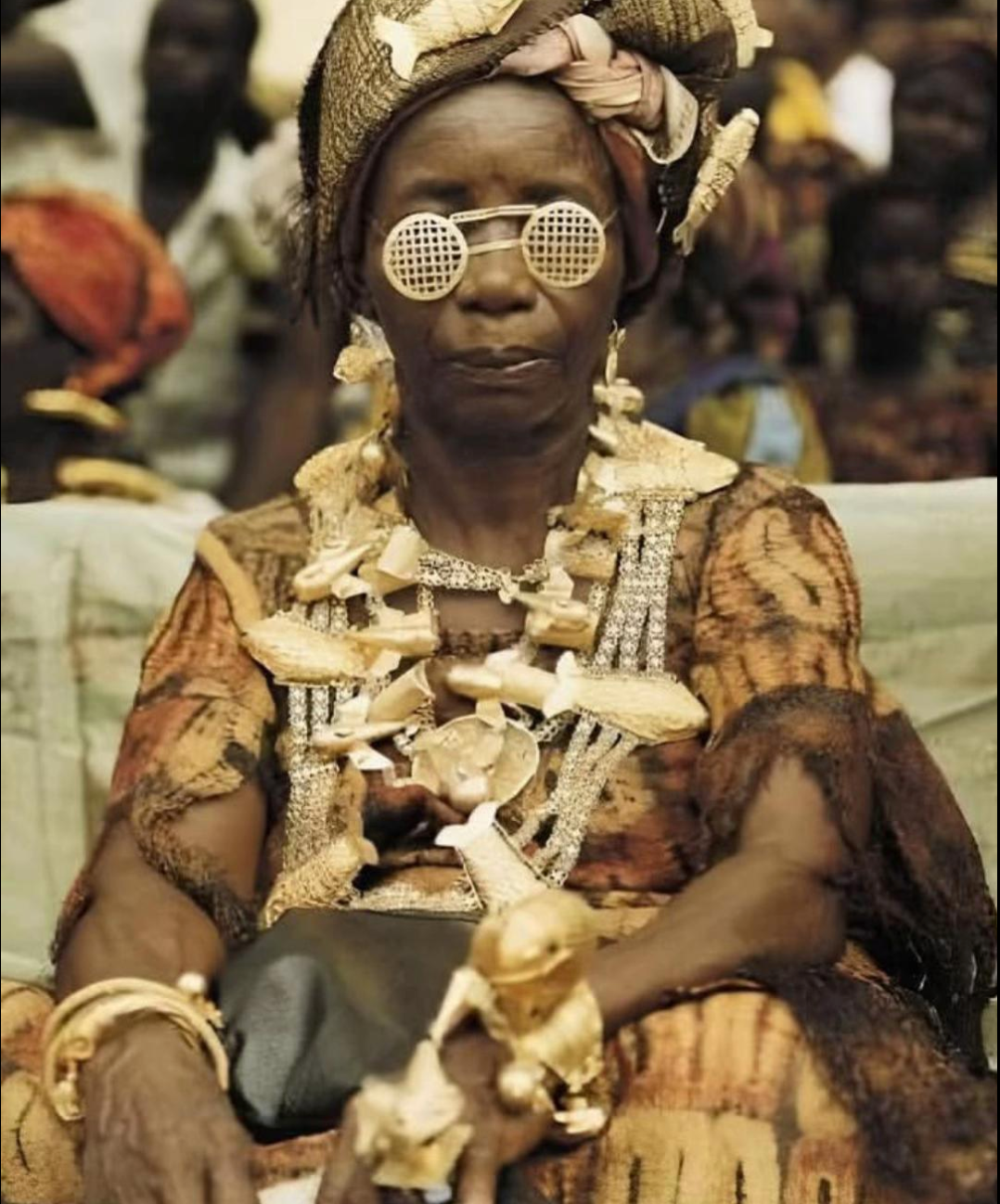
Photo credit: Jean-Yves Clavreul (Portraits of Anyi leaders). Photographer: J.C. Nourault, Ivory Coast (Period 1950-1970).

Photo credit: Jean-Yves Clavreul (Portraits of Anyi leaders). Photographer: J.C. Nourault, Ivory Coast (Period 1950-1970).

Photo credit: Jean-Yves Clavreul (Portraits of Anyi leaders). Photographer: J.C. Nourault, Ivory Coast (Period 1950-1970).

Photo credit: Jean-Yves Clavreul (Portraits of Anyi leaders). Photographer: J.C. Nourault, Ivory Coast (Period 1950-1970).

Photo credit: Jean-Yves Clavreul (Portraits of Anyi leaders). Photographer: J.C. Nourault, Ivory Coast (Period 1950-1970).

“Today, a gold-cast pair of eyeglasses might represent an audacious display of wealth; in the early twentieth century, however, that would have been a different matter in Akan society. For one thing, the eyeglasses belong to a corpus of European objects that gained currency as status symbols in Akan culture. Following their early association with Europeans, with whom the Akan have maintained contact since about 1500, eyeglasses had acquired a symbolic association with worldliness. Nevertheless, the issue of what type of eyeglasses the Akan owner of this pair intended is crucial to the interpretation. Were the glasses to be used for reading or as sun shades? Widely considered as a second pair of eyes, prescription eyeglasses were early on associated with superior eyesight and, by extension, intelligence, while dark shades reflected worldliness and, at times, even hidden powers. Still, in chiefly regalia, the eyeglasses take on a whole new meaning. Rendered in precious gold, they would have readily projected the wealth of the court. Gold in Akan culture is the quintessential expression of material well-being and, given its common use in political art, the appearance of yet another regalia item in the medium should otherwise not raise eyebrows. However, with wire mesh in place of the glass lenses, this example clearly served no practical purpose other than display. The eyeglasses would have impeded rather than enhanced eyesight. The critical focus, there-fore, should be the owner's desire to trumpet his cosmopolitan taste.” -Through African Eyes: The European in African Art, 1500 to Present, by Nii O. Quarcoopome. Detroit Institute of Arts. (2010).